
Nanga Parbat Expedition Overview
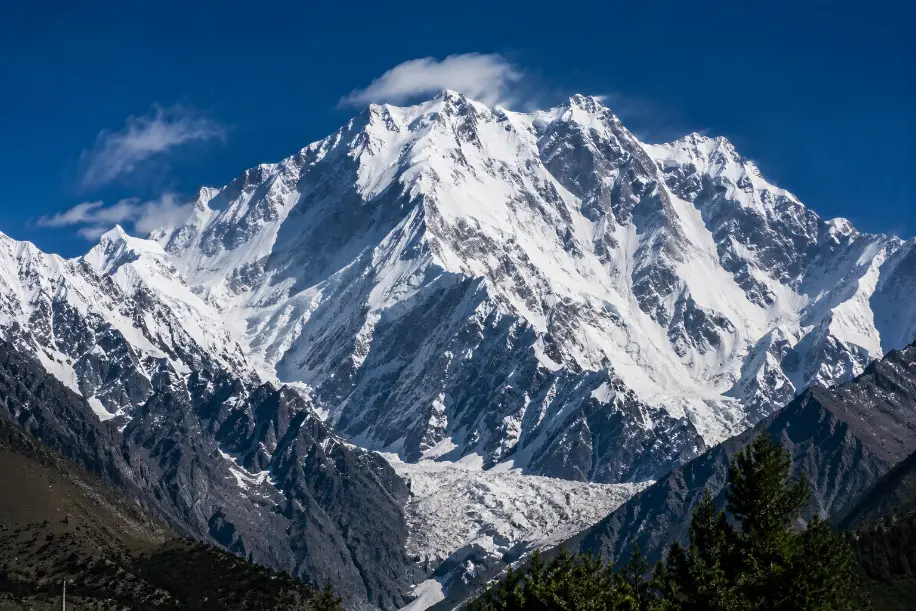
Standing at 8,126 meters (26,660 feet), Nanga Parbat is the ninth-highest mountain in the world and the westernmost peak of the Himalayan Range. Known as the legendary “Killer Mountain,” it is one of the most demanding and rewarding mountaineering objectives on Earth. Located in the Diamer District of Gilgit-Baltistan, Pakistan, Nanga Parbat attracts experienced climbers seeking a challenging 8,000-meter expedition with breathtaking alpine scenery and rich mountaineering history.
The Nanga Parbat Expedition begins in Islamabad, then travels along the famous Karakoram Highway to Chilas and Fairy Meadows. From here, climbers trek to Nanga Parbat Base Camp, where the expedition transitions from trekking to technical high-altitude climbing. The ascent involves glacier travel, steep snow-and-ice slopes, exposed ridges, and multiple high camps before the summit push.
Reaching the summit of Nanga Parbat rewards climbers with spectacular panoramic views of the Himalayas, Karakoram, and Hindu Kush mountain ranges. Supported by experienced guides, professional logistics, and carefully planned acclimatisation, this expedition is designed for skilled mountaineers aiming to conquer one of the world’s most iconic 8,000-meter peaks.
Nanga Parbat Expedition Highlights
Climb Nanga Parbat (8,126m), the world’s ninth-highest mountain.
Trek through the spectacular Fairy Meadows and Raikot Valley.
Experience one of Pakistan’s most iconic high-altitude expeditions.
Climb via the classic Diamir Face route.
Fully guided expedition with experienced climbing professionals.
Carefully planned acclimatisation and summit rotations.
Witness breathtaking views of the Himalayas, Karakoram, and Hindu Kush.
Explore the culture and hospitality of Gilgit-Baltistan.
Professional Base Camp support, logistics, and safety management.
What’s Included & Excluded
| INCLUDED |
|
||||||||||||||||||||
| NOT INCLUDED |
|
Additional information
| location | Diamir District, Gilgit-Baltistan, Pakistan |
|---|---|
| duration | 45 Days / 44 Nights |
| tour type | Mountaineering Expedition |
| destination | Nanga Parbat (8,126m) |
| group size | 10 people |
45-Day Nanga Parbat Expedition Itinerary
Day 01: Arrival in Islamabad, Pakistan
- Altitude: 540 meters
- Weather: Warm and pleasant
Welcome to Pakistan! Upon arrival at Islamabad International Airport, our representative will warmly receive you and transfer you to your hotel. Depending on your arrival time, you may explore some of Islamabad’s famous attractions, including Faisal Mosque, Daman-e-Koh, and the Pakistan Monument. In the evening, your expedition leader will conduct a comprehensive briefing covering the climbing schedule, equipment inspection, safety procedures, and expedition logistics.
Accommodation: Hotel in Islamabad
Meals: Breakfast, Lunch, Dinner
Day 02: Drive from Islamabad to Chilas
- Altitude: 1,265 meters
- Driving Time: 10–12 Hours
After breakfast, we begin our scenic drive along the legendary Karakoram Highway toward Chilas. The journey offers spectacular views of the Indus River, lush valleys, and towering mountains. Along the way, we pass several picturesque towns before reaching Chilas for an overnight stay.
Accommodation: Hotel in Chilas
Meals: Breakfast, Lunch, Dinner
Day 03: Drive to Raikot Bridge – Jeep Ride to Tato – Trek to Fairy Meadows
- Altitude: 3,300 meters
- Driving Time: 3 Hours
- Trekking Time: 3–4 Hours
This morning we continue to Raikot Bridge before boarding local 4×4 jeeps for an exciting ride to Tato Village. From Tato, we begin our beautiful trek through alpine forests to Fairy Meadows, one of Pakistan’s most scenic destinations. Upon arrival, enjoy magnificent sunset views of Nanga Parbat’s massive south face.
Accommodation: Camping / Local Lodge
Meals: Breakfast, Lunch, Dinner
Day 04: Trek from Fairy Meadows to Nanga Parbat Base Camp
- Altitude: 4,200 meters
- Trekking Time: 5–6 Hours
Today’s trek passes through Beyal Camp before continuing across alpine meadows and glacial terrain toward Nanga Parbat Base Camp. As the mountain grows larger with every step, climbers are rewarded with breathtaking views of the Diamir Face. Upon arrival, the expedition team establishes Base Camp.
Accommodation: Base Camp (Camping)
Meals: Breakfast, Lunch, Dinner
Day 05: Rest and Acclimatization at Base Camp
- Altitude: 4,200 meters
Today is reserved for acclimatization and preparation. Climbers organize personal equipment, conduct communication checks, and receive technical instruction on glacier travel, fixed rope techniques, and emergency procedures. Short acclimatization hikes around Base Camp help the body adjust to the increasing altitude.
Accommodation: Base Camp (Camping)
Meals: Breakfast, Lunch, Dinner
Day 06: Load Ferry to Camp I and Return to Base Camp
- Maximum Altitude: 4,850 meters
- Climbing Time: 6–7 Hours
We begin transporting climbing equipment, food, fuel, and supplies to Camp I. This important rotation assists with acclimatization while preparing the higher camps for the summit attempt. After completing the load carry, we descend back to Base Camp.
Accommodation: Base Camp (Camping)
Meals: Breakfast, Lunch, Dinner
Day 07: Rest Day at Base Camp
- Altitude: 4,200 meters
A full recovery day is scheduled to maximize acclimatization before climbing higher. Climbers monitor weather forecasts, inspect equipment, and prepare for the first overnight stay on the mountain.
Accommodation: Base Camp (Camping)
Meals: Breakfast, Lunch, Dinner
Day 08: Climb to Camp I
- Altitude: 4,850 meters
- Climbing Time: 5–6 Hours
Today we leave Base Camp and climb to Camp I via rocky slopes, glacier crossings, and sections protected by fixed ropes. Upon arrival, we settle into camp and continue adapting to the higher elevation.
Accommodation: Camp I
Meals: Breakfast, Lunch, Dinner
Day 09: Climb to Camp II
- Altitude: 6,100 meters
- Climbing Time: 6–8 Hours
The route becomes progressively steeper as we ascend snowfields and ice slopes toward Camp II. Climbers move carefully while following fixed ropes installed by the expedition team. Camp II provides spectacular views across the western Himalayas.
Accommodation: Camp II
Meals: Breakfast, Lunch, Dinner
Day 10: Descend to Base Camp
- Altitude: 4,200 meters
- Climbing Time: 7–8 Hours
Following successful acclimatization at Camp II, we descend carefully back to Base Camp for several days of recovery. This rotation significantly improves the body’s adaptation before the summit push.
Accommodation: Base Camp (Camping)
Meals: Breakfast, Lunch, Dinner
Day 11: Rest and Recovery at Base Camp
- Altitude: 4,200 meters
Today is dedicated to rest, hydration, nutrition, and equipment maintenance. Weather updates are reviewed while preparing for the summit rotation.
Accommodation: Base Camp (Camping)
Meals: Breakfast, Lunch, Dinner
Day 12: Climb to Camp I
- Altitude: 4,850 meters
- Climbing Time: 5–6 Hours
We begin our summit rotation by climbing once again to Camp I. Climbers move efficiently along the familiar route while conserving energy for the higher camps ahead.
Accommodation: Camp I
Meals: Breakfast, Lunch, Dinner
Day 13: Climb to Camp II
- Altitude: 6,100 meters
- Climbing Time: 6–8 Hours
Continuing upward, we return to Camp II where final preparations are made for climbing higher toward Camp III.
Accommodation: Camp II
Meals: Breakfast, Lunch, Dinner
Day 14: Climb to Camp III
- Altitude: 6,700 meters
- Climbing Time: 6–7 Hours
Today’s ascent follows steep snow and mixed terrain to Camp III. Climbers remain focused on pacing, hydration, and safety while the expedition team monitors weather conditions for the summit attempt.
Accommodation: Camp III
Meals: Breakfast, Lunch, Dinner
Day 15: Rest, Summit Preparation and Weather Contingency
- Altitude: 6,700 meters
A rest day at Camp III allows climbers to recover before moving higher. Guides review summit strategy, oxygen systems (if used), communication procedures, and weather forecasts to identify the safest summit window.
Accommodation: Camp III
Meals: Breakfast, Lunch, Dinner
Day 16: Climb to Camp IV
- Altitude: 7,200 meters
- Climbing Time: 6–8 Hours
- Weather: Cold and windy; temperatures may fall below -20°C
Leaving Camp III early in the morning, we continue climbing towards Camp IV via steep snow slopes and exposed ridges. The route demands careful movement on fixed ropes while maintaining a steady pace at extreme altitude. Upon arrival, climbers rest, hydrate, and prepare equipment for the summit push.
Accommodation: Camp IV
Meals: Breakfast, Lunch, Dinner
Day 17: Summit Nanga Parbat (8,126m) and Descend to Camp III
- Maximum Altitude: 8,126 meters
- Climbing Time: 12–16 Hours
- Weather: Extremely cold; temperatures may drop below -30°C
Summit day begins before midnight as we leave Camp IV under the stars. The route follows steep snowfields, mixed terrain, and exposed sections leading to the summit of Nanga Parbat (8,126m), the ninth-highest mountain in the world. From the summit, climbers enjoy breathtaking panoramic views across the Himalayas, Karakoram, and Hindu Kush before carefully descending to Camp III.
Accommodation: Camp III
Meals: Breakfast, Lunch, Dinner
Day 18: Descend to Base Camp
- Altitude: 4,200 meters
- Climbing Time: 8–10 Hours
After breakfast, we descend safely through Camp II and Camp I before returning to Nanga Parbat Base Camp. The remainder of the day is reserved for rest, celebration, and recovery after a successful summit.
Accommodation: Base Camp (Camping)
Meals: Breakfast, Lunch, Dinner
Day 19: Weather Contingency Day
- Altitude: 4,200 meters
This day is reserved as a contingency for unfavorable weather or additional acclimatization if required. If the summit has already been completed, climbers can relax at Base Camp and enjoy the spectacular surroundings.
Accommodation: Base Camp (Camping)
Meals: Breakfast, Lunch, Dinner
Day 20: Trek from Base Camp to Fairy Meadows
- Altitude: 3,300 meters
- Trekking Time: 5–6 Hours
Today we dismantle Base Camp and begin our return trek via Beyal Camp to the beautiful Fairy Meadows. The lush alpine scenery offers a refreshing contrast to the high-altitude environment of the expedition.
Accommodation: Camping / Local Lodge
Meals: Breakfast, Lunch, Dinner
Day 21: Trek to Tato Village – Jeep to Raikot Bridge – Drive to Chilas
- Altitude: 1,265 meters
- Trekking Time: 3 Hours
- Driving Time: 4–5 Hours
After breakfast, we descend to Tato Village before boarding jeeps for the thrilling ride back to Raikot Bridge. From there, we continue by road to Chilas for an overnight stay.
Accommodation: Hotel in Chilas
Meals: Breakfast, Lunch, Dinner
Day 22: Drive from Chilas to Islamabad
- Altitude: 540 meters
- Driving Time: 10–12 Hours
Following the Karakoram Highway once again, we travel back to Islamabad while enjoying spectacular mountain scenery and river valleys along the route.
Accommodation: Hotel in Islamabad
Meals: Breakfast, Lunch, Dinner
Day 23: Free Day in Islamabad
- Altitude: 540 meters
Enjoy a relaxing day in Islamabad for sightseeing, shopping, or simply unwinding after your expedition. This day also serves as a contingency in case of travel delays from the mountains.
Accommodation: Hotel in Islamabad
Meals: Breakfast, Lunch, Dinner
Day 24: Weather Contingency Day
- Altitude: 540 meters
An additional contingency day has been included to accommodate possible delays caused by weather, road conditions, or operational requirements during the expedition.
Accommodation: Hotel in Islamabad
Meals: Breakfast, Lunch, Dinner
Day 25: Reserve Day for Summit or Expedition Delays
This reserve day provides additional flexibility in case the summit attempt is postponed due to adverse weather or changing mountain conditions. Safety always remains the highest priority throughout the expedition.
Accommodation: As per expedition progress
Meals: Breakfast, Lunch, Dinner
Day 26: Expedition Reserve Day
A second reserve day is allocated for unexpected delays, acclimatization adjustments, or additional climbing rotations if required by the expedition leader.
Accommodation: As per expedition progress
Meals: Breakfast, Lunch, Dinner
Day 27: Reserve Day
This contingency day ensures sufficient flexibility to maximize summit success while maintaining safe climbing practices under changing mountain conditions.
Accommodation: As per expedition progress
Meals: Breakfast, Lunch, Dinner
Day 28: Reserve Day
Extra reserve time allows the expedition team to respond safely to weather windows, route preparation, or other logistical requirements.
Accommodation: As per expedition progress
Meals: Breakfast, Lunch, Dinner
Day 29: Expedition Contingency Day
An additional contingency day is available should the expedition require more time for summit attempts or safe descent.
Accommodation: As per expedition progress
Meals: Breakfast, Lunch, Dinner
Day 30: Final Expedition Reserve Day
The final reserve day provides maximum flexibility for summit scheduling and ensures adequate time to complete the expedition safely before returning to Islamabad.
Accommodation: As per expedition progress
Meals: Breakfast, Lunch, Dinner
Day 31: Weather Contingency / Summit Window
- Altitude: As per expedition progress
This day is reserved as an additional summit window if weather conditions earlier in the expedition were unfavorable. The expedition leader will assess forecasts and determine whether another summit attempt or climbing rotation is required. Safety and proper acclimatization remain the highest priorities.
Accommodation: As per expedition progress
Meals: Breakfast, Lunch, Dinner
Day 32: Descend to Nanga Parbat Base Camp
- Altitude: 4,200 meters
- Climbing Time: 7–9 Hours
Following the successful summit or completion of the climbing phase, we descend carefully through the high camps back to Nanga Parbat Base Camp. Upon arrival, enjoy a well-earned rest and celebrate the achievements of the expedition with the team.
Accommodation: Base Camp (Camping)
Meals: Breakfast, Lunch, Dinner
Day 33: Rest Day at Base Camp
- Altitude: 4,200 meters
Today is reserved for recovery after the demanding climb. Climbers organize equipment, rest, and prepare for the trek back through Fairy Meadows while enjoying the spectacular scenery surrounding Base Camp.
Accommodation: Base Camp (Camping)
Meals: Breakfast, Lunch, Dinner
Day 34: Trek from Base Camp to Fairy Meadows
- Altitude: 3,300 meters
- Trekking Time: 5–6 Hours
We begin our return journey, trekking through Beyal Camp to the lush alpine meadows of Fairy Meadows. This scenic trail offers one final opportunity to admire the magnificent south face of Nanga Parbat.
Accommodation: Camping / Local Lodge
Meals: Breakfast, Lunch, Dinner
Day 35: Trek to Tato Village – Jeep to Raikot Bridge – Drive to Chilas
- Altitude: 1,265 meters
- Trekking Time: 3 Hours
- Driving Time: 4–5 Hours
After breakfast, we descend to Tato Village before boarding local jeeps to Raikot Bridge. From there, we continue by road to Chilas for a comfortable overnight stay.
Accommodation: Hotel in Chilas
Meals: Breakfast, Lunch, Dinner
Day 36: Drive from Chilas to Islamabad
- Altitude: 540 meters
- Driving Time: 10–12 Hours
Travelling once again along the famous Karakoram Highway, we return to Islamabad while enjoying breathtaking views of valleys, rivers, and towering mountains along the route.
Accommodation: Hotel in Islamabad
Meals: Breakfast, Lunch, Dinner
Day 37: Free Day in Islamabad
- Altitude: 540 meters
Enjoy a relaxing day in Pakistan’s capital city. You may explore local markets, visit cultural landmarks, or simply unwind after completing one of the world’s most challenging mountaineering expeditions.
Accommodation: Hotel in Islamabad
Meals: Breakfast, Lunch, Dinner
Day 38: Departure from Islamabad
After breakfast, our representative will transfer you to Islamabad International Airport for your onward flight. As your Nanga Parbat Expedition concludes, you leave Pakistan with unforgettable memories of climbing the legendary 8,126-meter ‘Killer Mountain’ and experiencing the remarkable beauty of the western Himalayas.
Meals: Breakfast
FAQs About Nanga Parbat Expedition
The Nanga Parbat Expedition is considered one of the most challenging 8,000-meter climbs in the world. Climbers should have previous experience on technical peaks above 6,000 or 7,000 meters, be proficient in glacier travel, fixed rope climbing, and ice climbing, and possess excellent physical fitness and mental endurance. The expedition follows the classic Diamir Face (Kinshofer Route), which demands strong mountaineering skills and careful acclimatization.
The best season for the Nanga Parbat Expedition is from late June to early August. During these months, weather conditions are generally more stable, snow accumulation is lower, and climbers have the highest chance of finding a safe summit window. However, mountain weather can change rapidly, so flexibility is always essential.
Our Nanga Parbat Expedition is a 45-day program that includes arrival in Islamabad, travel to Fairy Meadows and Base Camp, acclimatization, climbing rotations, summit attempt, descent, and return to Islamabad. Extra contingency days are included to accommodate weather delays and maximize summit success.
We climb Nanga Parbat via the famous Diamir Face (Kinshofer Route), the standard route used by most successful expeditions. The approach begins from Raikot Bridge, continues through Fairy Meadows and Nanga Parbat Base Camp, and then ascends through Camps I, II, III, and IV before the summit push to 8,126 meters.
Participants should have previous experience on high-altitude expeditions, preferably including successful ascents of 6,000 or 7,000-meter peaks. Climbers must be comfortable using crampons, ice axes, fixed ropes, and ascending steep snow and ice terrain. Excellent physical conditioning and prior glacier travel experience are strongly recommended.
The expedition package includes hotel accommodation, airport transfers, ground transportation, meals during the expedition, climbing permits, Base Camp services, professional guides, porters, camping equipment, kitchen staff, and logistical support according to the itinerary. Personal climbing equipment, international flights, travel insurance, and personal expenses are not included.
K2 Adventure is a trusted Pakistani mountaineering company specializing in expeditions across the Karakoram and Himalayas. Our experienced local guides, professional Base Camp management, reliable logistics, and commitment to safety ensure that climbers receive the highest level of support throughout their Nanga Parbat Expedition.
Tour Reviews
There are no reviews yet.
Leave a Review