
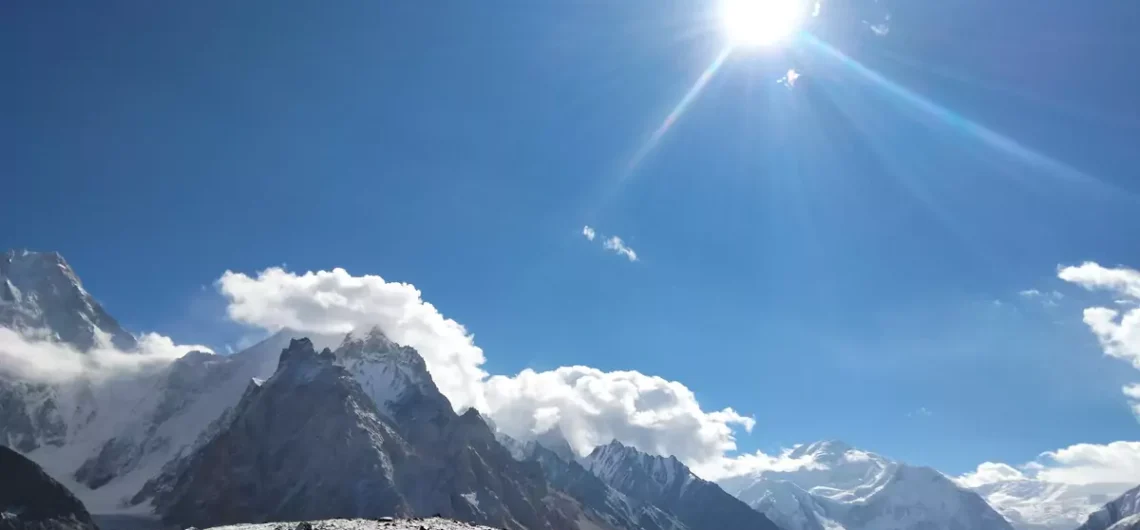
On K2, the world’s second-highest mountain, one truth stands above all: weather decides your fate. Every summit attempt begins and ends with how climbers manage its brutal, unpredictable conditions.This is not ordinary mountain weather.
K2 Weather patterns are so fierce and complex that the peak has earned the nickname”Savage Mountain.” Yet here is what many do not realize: success on K2 is not about luck. It comes from understanding the science, choosing your weather windows wisely, and having the right expertise to guide you through. At K2 Adventure Guides, we are proud to be local experts who have led successful expeditions on K2. Over the years, we have gained deep knowledge of the mountain’s unique weather patterns. In this guide, we share everything you need to know about K2 weather conditions, from base camp to the summit, so that you can plan your expedition with confidence.
Main Takeaway: Optimal summit success on K2 relies on mastering two narrow windows—pre-monsoon (late April–May) and post-monsoon (September–October)—alongside granular, altitude-tailored weather planning, rigorous acclimatization, and built-in safety margins.
Understanding K2 Extreme Weather Patterns
K2 weather is not random chaos. There’s a pattern, and once you understand it, you can work with it instead of against it.
Karakoram Climate System Overview
The Karakoram sits at the intersection of the westerlies and the South Asian monsoon/, creating what meteorologists call a “bi-modal precipitation regime.” Think of it as two weather systems fighting for control over your climbing window.
Here is what makes K2 weather so unique:
Winter (December–February): Mid-latitude cyclones dump heavy snow at high camps. These are not gentle snowfalls; we are talking blizzards that can bury fixed ropes and make camps uninhabitable.
Spring: Westerlies start weakening, but thermal convection increases. This creates unstable conditions that can change in minutes.
Summer: Monsoon clouds hit the southern slopes hard, but the K2 position creates a rain-shadow effect. The high-altitude core stays relatively dry—your golden opportunity.
Key weather features you will encounter:
- Massive temperature swings: Up to 20°C difference between day and night at Base Camp
- Katabatic winds: These glacial valley winds can reach gale force at night
- Intense solar radiation: Thin atmosphere means brutal UV exposure and rapid melt-freeze cycles
Monsoon Impact on K2 Conditions
The monsoon weather does not just bring rain—it reshapes the entire climbing landscape on K2.
Monsoon Timeline:
- Early June: Humid air pushes up to 5,000m, but upper elevations stay dry
- Mid-August: Withdrawal begins
- Early September: Skies clear, creating your second weather window
Weather Breakdown for K2 Expeditions
Let’s get specific. Here’s what K2 weather looks like month by month so that you can time your expedition perfectly.

Winter Conditions (December–February)
Bottom line: Don’t attempt K2 in winter unless you are part of an elite team with years of extreme cold experience.
Temperature reality check:
- Skardu (2,500m): -5°C to 5°C during the day
- Base Camp (5,150m): -20°C to -10°C during the day
Hazards that will end your expedition:
- Blizzards with 100+ km/h winds
- Heavy snow loading that increases avalanche risk on the Abruzzi Spur
- Extreme cold that makes frostbite and hypothermia almost inevitable
Our recommendation: Use winter for lower-altitude acclimatization hikes only.
Pre-Monsoon Window (April–May)
This is your first shot at the summit. Weather conditions start stabilizing, and you get those precious calm days.
Temperature trends:
- Skardu (2,200m): 15°C to 25°C by late May
- Base Camp: -5°C to 0°C (day), -15°C to -10°C (night)
Why this window works:
As the snow melts, mountain edges become more defined and snow bridges over deep glacier cracks stabilize, making movement safer. During this period, high-pressure systems from the west often bring 4–10 consecutive days of calm weather, especially in the third and fourth weeks of May.
Pro tip: Late May usually offers some of the most stable climbing conditions of the entire year.
Summer Climbing Season (June–August)
Summer on K2 is not like summer anywhere else. You are dealing with unique challenges that require specific preparation.
Base camp weather:
- Day: 0°C to 10°C
- Night: -10°C to -5°C
- Wind: At night, katabatic winds can roar down the slopes with gusts up to 70 km/h, while daytime winds are usually more moderate, averaging 20–30 km/h.
Climbing conditions:
- Snow and ice mix: The terrain is generally crampon-friendly, with a mix of snow and hard ice.
- Harsh sunlight: Extreme UV exposure makes specialized eyewear essential to protect your eyes.
- Afternoon storms: Rapidly forming storms in the afternoon often delay summit attempts.
The challenge: Because of these weather patterns, climbers usually postpone using supplemental oxygen until the final summit push.
Post-Monsoon Opportunities (September–October)
Your Second Weather Window: Often considered the most beautiful climbing season of the year.
What makes it special:
- Exceptional visibility reduces the danger of hidden glacier cracks.
- Stabilized snowpack forms after the early September storms.
- Lower avalanche risk compared to earlier in the season.
- Crystal-clear skies make navigation easier.
Temperature trends: Conditions are similar to pre-monsoon, but it gets noticeably colder by late October.
The catch: As winter approaches, these weather windows become shorter, making timing absolutely critical.
Altitude-Specific Weather Analysis
K2’s weather changes dramatically with altitude. Here is what you will face at each elevation.

Skardu to Askole Conditions (2,500–3,000m)
Day temperatures: 15-25°C (May)
Night temperatures: 5-10°C
Weather patterns: Afternoon thunderstorms are common, but mornings stay clear. Perfect for early starts and gear preparation.
Concordia Weather Patterns (4,700m)
Day temperatures: 0-5°C
Night temperatures: -10 to 5°C
Key challenge: Monsoon cloud buildups and strong winds. This is where weather planning becomes critical for your approach to base camp.
K2 Base Camp Weather (5,150m)
Day temperatures: -5 to 0°C
Night temperatures: -15 to -10°C
Reality check: It’s dry, but wind-chill dominates. This is where many expeditions fail, not from storms, but from underestimating the constant cold.
K2 Peak Weather & Summit Zone (Above 7,000m)
Welcome to the death zone, where the weather becomes your biggest enemy.
Camp I-III Zones (6,000-7,000m):
- Day: -10 to -5°C
- Night: -20 to -15°C
- Thin air amplifies weather effects
- Frequent high winds
Summit Zone (7,000-8,611m):
- Day: -20 to -30°C
- Night: -35 to -45°C
- Extreme winds up to 100+ km/h
- Low oxygen makes everything harder
The brutal truth: At these temperatures, exposed skin freezes in minutes. Weather windows become life-or-death timing decisions.
Weather Decision Framework For K2
Climbers on K2 need a structured approach to making safe weather decisions. Here is how experienced teams typically assess and respond to conditions:
Weather Window Identification
- Multi-model forecasting: Instead of relying on a single forecast, climbers compare data from multiple models (e.g., ECMWF, GFS) along with local readings for the most accurate outlook.
- Go/no-go criteria: Many expeditions aim for winds below 30 km/h at 8,000m, nighttime lows warmer than –35°C, and at least 72 hours with no heavy precipitation above 6,000m.
- Real-time monitoring: Automated weather stations placed at higher camps provide frequent updates, helping teams match forecasts with actual conditions.
Safety Protocols
- Turnaround times: Summit pushes generally have strict turnaround cutoffs (for example, early afternoon) to avoid being caught in night storms.
- Rope deployment: Fixed ropes are usually set only during periods of stable weather, when winds are consistently below safe thresholds.
- Emergency shelters: Some expeditions pre-place insulated tents with food and communication equipment at critical high points in case of sudden weather shifts.
Essential Weather Preparation for K2 Expeditions
The right gear and acclimatization strategy can mean the difference between summit success and evacuation.
Gear Requirements by Season
Pre/Post-Monsoon essentials:
- 800g down parka and bib pants
- Triple-layer system: merino base, fleece mid, waterproof shell
- High-altitude helmets with face shields
Summer additions:
- Lightweight 600g down jacket
- UV-rated glacier glasses (category 4)
- SPF 50+ sunscreen
- Mixed-terrain crampons (10-12 points)
Winter requirements:
- Full down suit (1,200g fill)
- Double-boot system with 800g liners
- High-cold bivouac tents and snow anchors
Acclimatization Strategies
Staged rotations that work:
- Skardu → Askole trek for initial elevation gain
- Establish Base Camp; day climbs to 5,500m, return to 5,150m
- Progressive camps: Camp I (6,100m), Camp II (6,700m), Camp III (7,200m)
Rest cycles: “Climb high, sleep low” with spacing every 3 days prevents altitude sickness.
Supplemental oxygen: Begin above Camp III; calibrate flow to maintain at least 30% SpO₂.
Latest K2 Weather Updates & News
Weather patterns on K2 are changing. Recent seasons have shown:
- Shorter weather windows
- More unpredictable storm patterns
- Extended monsoon seasons are affecting traditional climbing windows
Want real-time K2 weather updates for your expedition planning?
Our K2 Adventure team provides live weather analysis and route condition reports throughout climbing season.
Master K2 Weather With Expert Guidance
Weather mastery on K2 from understanding monsoonal cloud dynamics to summit-zone winds ,combined with meticulous gear selection, acclimatization, and clear safety thresholds, is the foundation of expedition success. A robust decision framework ensures that your push for the summit aligns with nature’s narrow windows of stability.
Ready to plan your K2 expedition with weather experts who’ve been there?
Our team combines decades of K2 experience with real-time weather analysis to maximize your chances of summit success.
Start Planning Your K2 Expedition →
At K2 Adventure Guides, we have successfully led expeditions during both the pre-monsoon and post-monsoon weather windows. This experience has helped us maintain a 100% client safety record while achieving some of the highest summit success rates in the industry.
Comments