

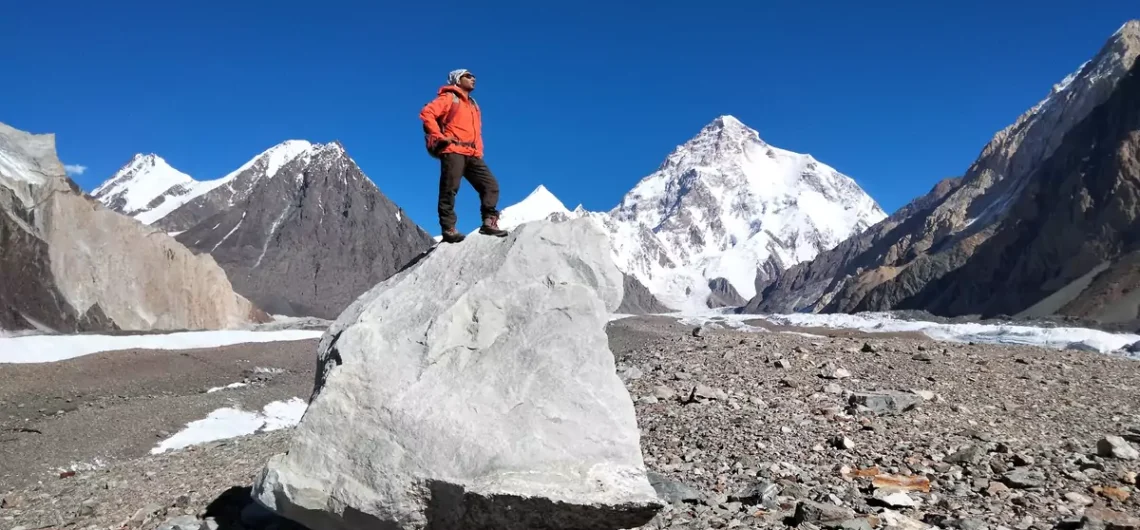
Discover the complete story of K2’s climbing history. Learn about deadly first attempts and modern record-breaking climbs on Pakistan’s tallest mountain.
K2 stands 8,611 meters tall on the Pakistan-China border. This makes it the world’s second-highest mountain. People call it the “Savage Mountain” because it kills nearly one person for every ten who reach the top.
Unlike Mount Everest, K2 offers no easy path. Every step demands skill and courage. The mountain tests your limits in ways that few peaks can match.
This is the complete story of humanity’s 150-year battle with the world’s most feared mountain.
What Makes K2 So Dangerous?
K2 isn’t just another tall mountain. It’s a deadly pyramid of rock and ice. The mountain sits in Pakistan’s Karakoram Range. Several things make it extremely dangerous.
The weather changes fast and without warning. Storms can trap climbers for weeks. A routine climb can quickly become a fight for survival. The mountain has technical sections that demand expert skills. Unlike Everest, K2 has no established infrastructure. It remains wild and unpredictable.
Local Balti people call it “Chogori.” This means “Great Mountain.” But mountaineers worldwide know it by a simpler name: K2.
When was K2 First Discovered and How Did It Get Its Name?
The year was 1856. Lieutenant Thomas George Montgomerie was mapping India’s mountains. He worked for the British Royal Engineers. From 200 kilometers away, he spotted a massive peak on the horizon.
Montgomerie labeled peaks with “K” for Karakoram. He numbered them as he found them. Other peaks got local names later. K1 became Masherbrum. K3 became Gasherbrum IV. But K2 kept its survey name.
The mountain was too remote for most local people to visit. This meant no single local name became popular. Captain Henry Godwin-Austen later mapped the area in detail. He measured K2’s height at 8,619 meters. This was very close to today’s official measurement.
People briefly called it “Mount Godwin-Austen.” But the simple name K2 stuck. Sometimes the most technical names become the most memorable.
Which Expeditions Attempted K2 Before the First Successful Ascent?
The First Try (1902)
Oscar Eckenstein led the first serious attempt on K2. His team included Aleister Crowley. Crowley later became famous as an occultist, not a climber.
The team tried the Northeast Ridge. They reached 6,525 meters before giving up. They spent 68 days on the mountain. Only eight days had clear weather. Crowley got malaria. The team fought among themselves. The harsh conditions beat them down.
Still, they did well with primitive equipment. It took them fourteen days just to reach the mountain’s base. Modern expeditions fly there in hours.
The Italian Duke Gives Up (1909)
Prince Luigi Amedeo led a well-equipped Italian team. They reached about 6,250 meters on the Abruzzi Spur. They quit because the route was too steep. But this route later became the standard path to the top.
The Duke tried other routes on the west and northeast sides. None worked. He made a bold statement: “K2 will never be climbed.” Then he went to climb nearby Chogolisa instead.
The Duke was wrong about K2. But he was right about the best route.
American Teams Get Close
Charles Houston led an American team in 1938. They reached about 8,000 meters. More importantly, they proved the Abruzzi Spur was the best route. This gave future teams valuable information.
Fritz Wiessner’s 1939 team came very close to success. They reached 8,382 meters. That was only 229 meters from the top. But tragedy struck. Team member Dudley Wolfe got stuck at high altitude. He died along with three Sherpas who tried to save him.
Houston returned in 1953 with another team. They faced disaster during a ten-day storm. Team member Art Gilkey got very sick. During a desperate retreat, Pete Schoening made the legendary “Belay.” He stopped a fall that could have killed the whole team. Gilkey died later, possibly sacrificing himself to save others.
These expeditions taught a hard lesson: K2 demands the ultimate price from those who challenge it.
How Did the 1954 Italian Expedition Successfully Reach K2 Summit?
Professor Ardito Desio led the Italian team that finally conquered K2. They planned carefully and organized well. They also got lucky with the weather. The team had 11 Italian climbers and 10 Hunza high-altitude porters.
The expedition included experienced climbers Achille Compagnoni and Lino Lacedelli. They would reach the summit. Young Walter Bonatti was also on the team. The team had internal problems. Members privately called Desio “il Ducetto” (little Mussolini). But they stayed focused on their goal.
Tragedy hit when Mario Puchoz died of pneumonia at Camp II. The team kept going. They set up camps along the Southeast Ridge despite bad weather.
On July 31, 1954, Compagnoni and Lacedelli left their final camp. They were going for the summit. They picked up oxygen tanks that Bonatti and porter Amir Mehdi had carried up under dangerous conditions.
At about 6:00 PM, the two Italians reached K2’s summit. They became the first humans to stand on top of the world’s second-highest mountain. Lacedelli wanted to leave right away. Compagnoni wanted to spend the night on top. Lacedelli even threatened him with an ice axe.
They climbed down in the dark. They reached Camp VIII around 11:00 PM. The world celebrated their achievement. It happened just fourteen months after Hillary and Tenzing climbed Everest.
For the truly adventurous, take on the iconic K2 Base Camp Trek an unforgettable journey into the heart of the Karakoram.
What are the Most Significant K2 Expeditions Since 1954?
First Pakistani on Top
Ashraf Aman became the first Pakistani to reach K2’s summit. This happened on August 9, 1977. He climbed with a Japanese expedition led by Ichiro Yoshizawa. This meant a lot because a Pakistani had reached the top of his country’s highest mountain.
Nazir Sabir followed on August 7, 1981. He’s Pakistan’s most famous mountaineer. He took a new route via the West Ridge and Southwest face. This made him the only Pakistani to reach an 8,000-meter summit by a new route.
All-Pakistani Team Success
The 2014 Pakistani Team Expedition made history. It was the first all-Pakistani group to reach the summit. Six climbers made it to the top. This included 24-year-old Ali Durrani. He became the youngest Pakistani to climb K2.
The team came from famous climbing villages in Gilgit-Baltistan. These included Sadpara, Shigar, Hushe, and Shimshal valleys. These communities have produced world-class climbers for generations.
How Has K2 Climbing Safety and Success Rates Evolved?
The Deadly 1986 Season
People call 1986 K2’s “Black Summer.” Thirteen climbers died out of 27 who tried to reach the summit. But Polish climber Wanda Rutkiewicz became the first woman to reach K2’s top. French climber Liliane Barrard followed minutes later. Sadly, she and her husband died during the descent.
The 2008 Disaster
August 1, 2008, was the worst single day in K2’s history. An ice avalanche hit the Bottleneck area. It killed 11 climbers from different international teams. The ice collapse destroyed the fixed ropes. It trapped climbers in one of the mountain’s most dangerous spots.
Winter Climbing and New Records
2021 brought a historic breakthrough. A team of 10 Nepali climbers completed the first winter climb of K2. They reached the summit on January 16th. Team leader Nirmal “Nims” Purja did it without extra oxygen. He became the first person to summit K2 in winter without bottled oxygen.
Recent years have seen amazing achievements:
- Shehroze Kashif climbed both Everest and K2 in the same year at age 19 (2021)
- Benjamin Védrines broke the K2 speed record in 2024. He climbed alone without oxygen in just 10 hours, 59 minutes, and 59 seconds
- Mingma David Sherpa holds the record with six K2 summits
How Has K2 Climbing Safety and Success Rates Evolved?
K2 Pakistan has become much safer over 70 years of climbing. But it’s still way more dangerous than other big mountains. Success rates went up from 20% in the 1950s to 65% in the 2020s. Death rates dropped from 50% to 12% over the same time.
Progress by Decade
1950s: Climbers used basic equipment and oxygen systems. Death rates were extremely high as people learned about the mountain’s dangers.
1960s-70s: Better gear and weather knowledge helped. But death rates stayed high at 29%.
1980s-90s: Weather forecasts and satellite communication improved. Death rates dropped to 25%.
2000s-2010s: GPS navigation and modern fabrics helped a lot. Rescue protocols got better. Success rates hit 45% while deaths fell to 15%.
2020s: Real-time weather data changed everything. Drones help with planning. Medical knowledge improved. Success rates reached 65% with 12% death rates.
Current Numbers
About 800 climbers have reached K2’s summit by 2024. Around 96 people have died trying. This gives a death rate of about 12%. This big improvement from the old rate of 25% shows better safety, equipment, and weather forecasting.
Mount Everest has a 3.9% death rate with over 6,000 successful climbs. This makes K2 about 10 times more dangerous than Everest.
Pakistani Mountain Experts
Modern expeditions rely heavily on Pakistani high-altitude porters. They come from villages like Sadpara, Hushe,Askoli and Shimshal in Gilgit-Baltistan. These communities have special high-altitude rescue skills. The Concordia Rescue Team is one of the world’s highest-operating mountain rescue units.
Local experts working with international teams has made expeditions much safer. These mountain communities have generations of knowledge about k2 weather patterns, routes, and survival techniques.
Ready to explore northern Pakistan’s mountains? As local K2 adventure guides, we lead you beyond the trails into the heart of the Karakoram, where legendary traditions and breathtaking landscapes shape every journey.
Your K2 Base Camp Adventure
You don’t need to be an expert climber to experience K2. The trek to K2 Base Camp offers an incredible adventure for determined hikers. The journey through the Baltoro Glacier region shows you four of the world’s fourteen highest peaks.
Key highlights:
- Amazing views of K2, Broad Peak, and Gasherbrum peaks
- Walking on the Baltoro Glacier, one of the world’s longest glaciers
- Meeting expedition teams getting ready for summit attempts
- Experiencing unique Balti mountain culture
- Photography opportunities that rival anywhere on Earth
The typical K2 Base Camp trek takes 12-14 days. You need good fitness but no climbing skills. Our experienced local guides keep you safe. They share deep knowledge of the region’s geography, culture, and climbing history.
Conclusion: K2’s Amazing Story
K2’s climbing history reads like an epic adventure story. It’s filled with triumph, tragedy, and human determination pushed to the limit. From early 1900s expeditions to today’s record-breaking achievements, every chapter adds to the mountain’s legendary status.
The change from a 50% death rate to today’s 12% shows human progress. Better technology, planning, and respect for local knowledge made the impossible more achievable. Yet K2 remains the ultimate test for the world’s best mountaineers.
For the rest of us, K2 offers different inspiration. The mountain’s story teaches us about never giving up. It shows us the importance of careful planning. It reminds us to respect forces greater than ourselves.
Whether you’re planning a Base Camp trek or just love mountain stories, K2 continues to capture hearts worldwide.
Ready to see K2’s majesty up close? Contact our expert team to plan your Base Camp adventure or cultural expedition through Pakistan’s incredible mountain regions. Our local guides have decades of experience. They love sharing their homeland’s natural wonders with adventurous travelers.
Comments